
Exploratory modeling, draft simulations, and notes from the field
We explored impact on stable employment markets with an influx of AI-assisted novice workers across multiple employment sectors. Using an Agent Based Model (ABM), we assessed the interactions of a market with human experts (blue; high utility, high cost) with incoming AI-empowered novice humans (red; varying utility, lower cost). Idealized market-specific parameters for workers in auto tech, software engineering, graphic design, and copywriting fields were used to provide a variety of scenarios. In all cases, the established expert workers also were allocated boosts in capability due to AI similar to those that the novice entrants received.
Exploration: Structural Transformation and Collapse of Markets with AI Influx
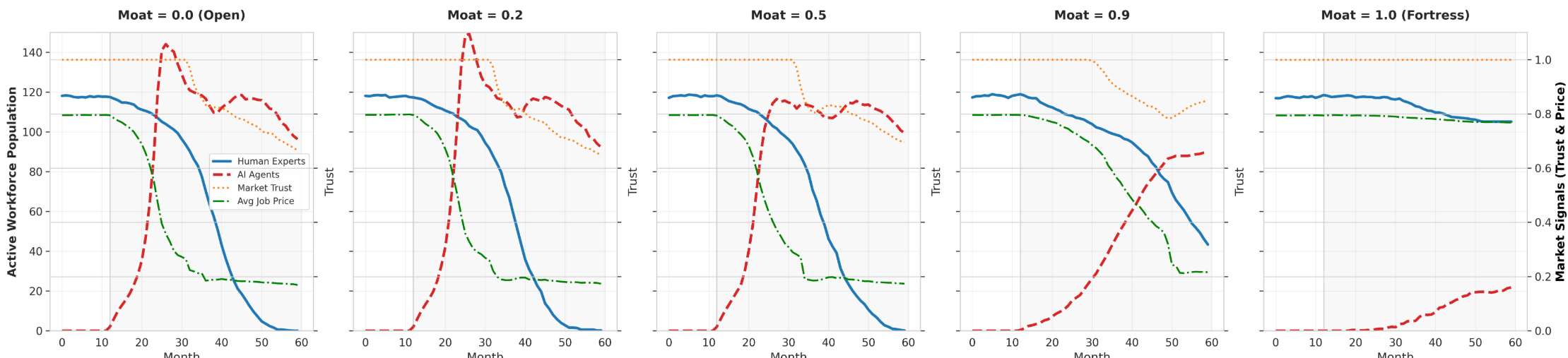
Figure 1: In a generic market case, we observed a potential failure mode of market signal collapse. When the volume of plausible-but-unverified bids is high, the global pricing anchor (what clients think a job costs) falls faster than the "trust signal" (what clients think a worker is worth) can correct it. Note how arrival of incoming AI-powered novice workers resets the market price point (green) and a very strong credentialing “moat” is required to protect wages, trust, and employment levels.
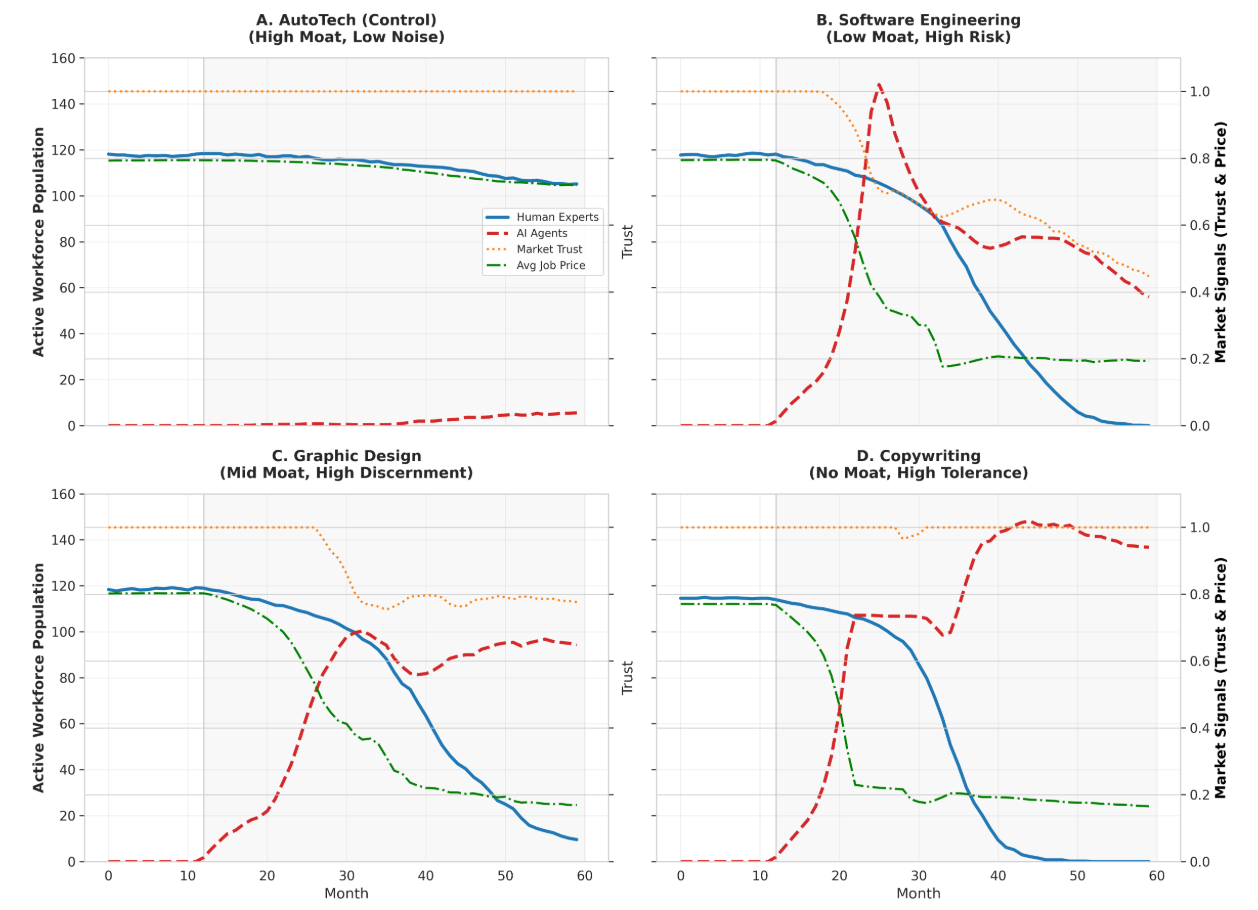
Figure 2: Simulation of four archetypal sectors. We observe that open talent markets are structurally unstable in the presence of generative AI that artificially elevates many new workers to a moderate level of competence. The auto tech sector survives relatively unscathed due to the strong credentialing and brick-and-mortar nature of the business, while copywriting, where work product can be generated at exceedingly low cost and sufficiently high quality with high output volume, quickly is transformed to commodity. Note that the work blocks bid on in each sector were identical; we expect a realistic case might include both low-value, low-skill jobs that AI-empowered novices might take and high-value, high-skill jobs that would remain the domain of experts. The observed collapses in Software and Graphic Design may be artifacts of the current oversimplified distribution of jobs. In future work we will model a distribution of blocks of varied value and difficulty.
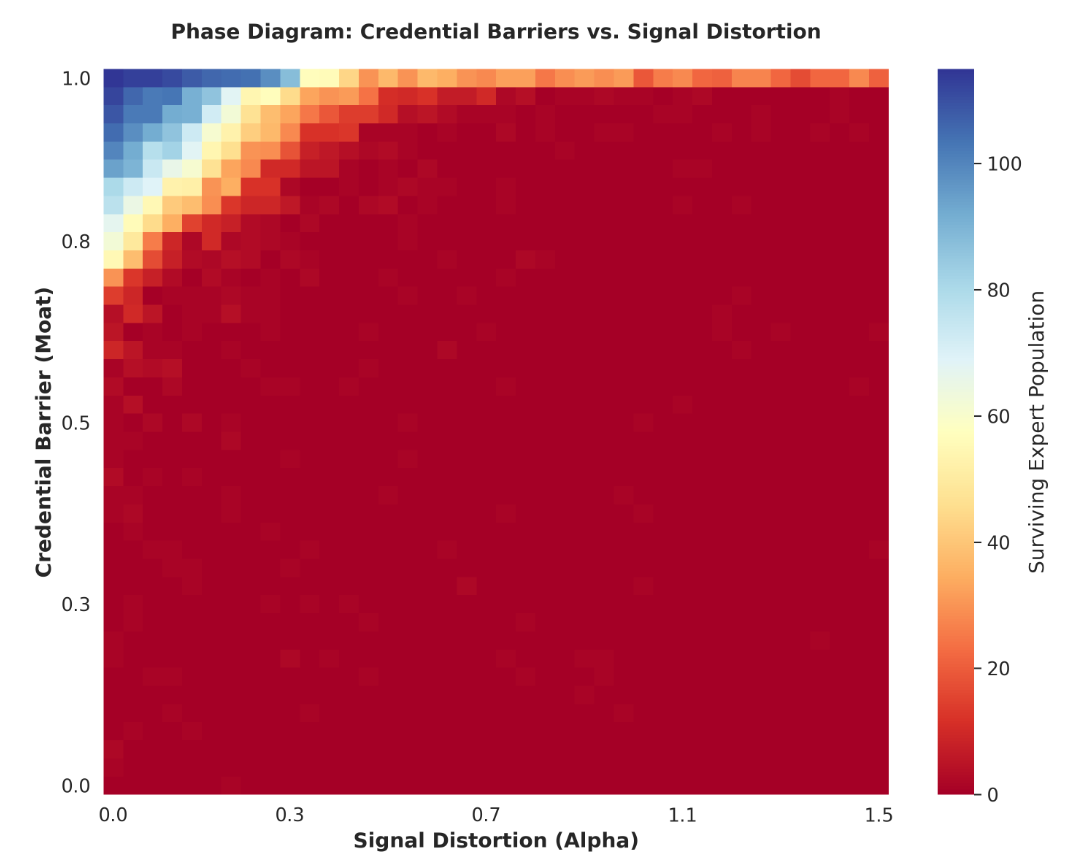
Figure 3: Explorations of the parameter space revealed dynamics where minimizing “signal distortion” — the AI-supported novices ability to present as skilled experts — was insufficient to stop the inflow of AI workers. The dynamics of meritocratic open markets encourage and reward lower cost entrants providing that their skill level meets a minimum viability level. Strong credentialing barriers were required to maintain a healthy population of established experts.
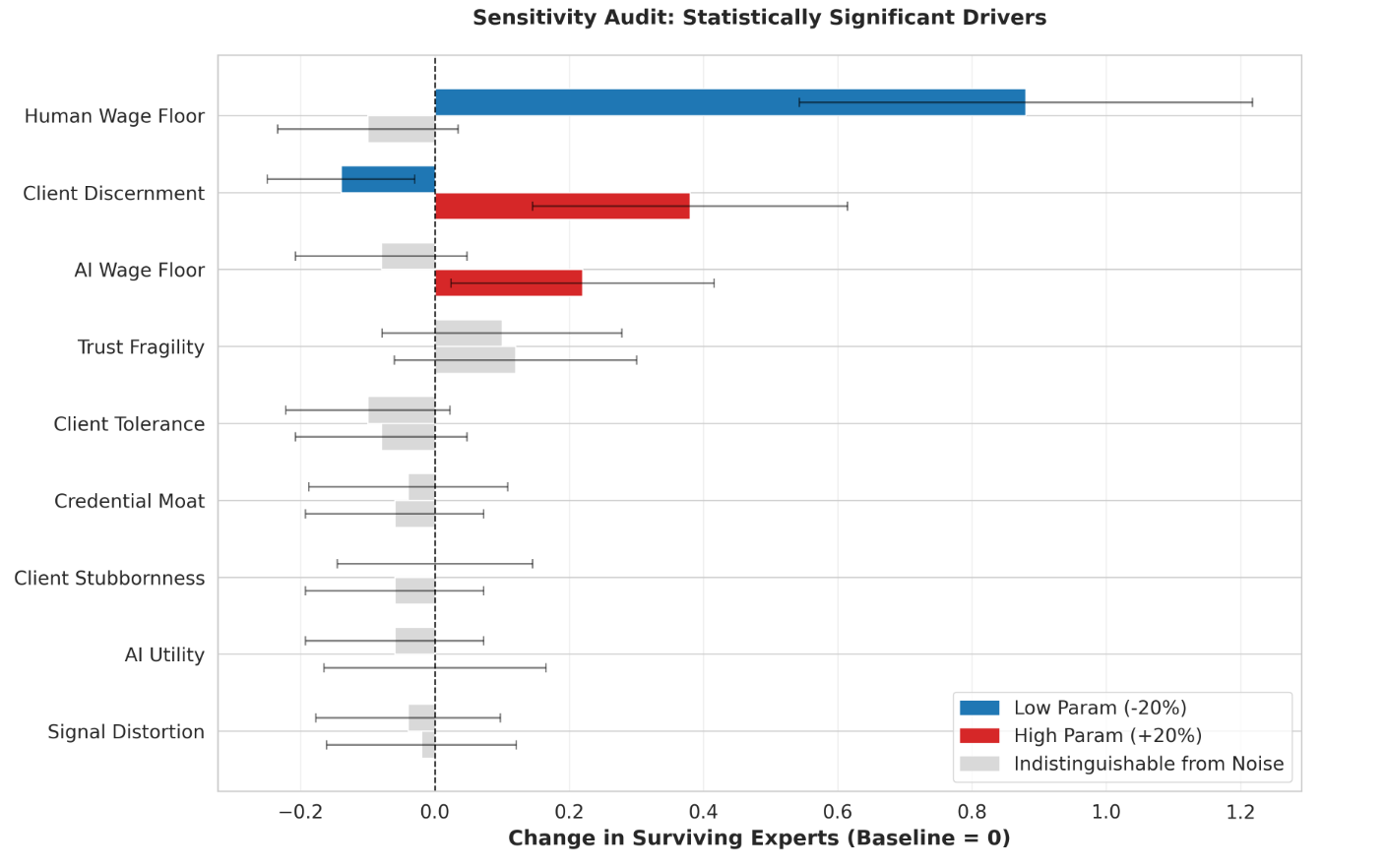
Figure 4: Sensitivity analysis of the parameter space demonstrates that incremental approaches are insufficient to stop the market collapse resulting from greatly enhanced labor that AI provides. Convincing workers to accept a low wage floor, and increasing clients’ insistence on high-quality output were the two most successful factors in maintaining a functioning job market.
A common challenge in many sectors is designing incentives that property motivate useful compliance (as opposed to performative compliance) with documentation policies. In this study, we explored the landscape of potential approaches to incentive structures with varying alignment with desired outcome. In this case, we can think of extremes as “bonus for filing a report” vs. “bonus for your report being read by others.” We compared these We simulated a broad set of incentive and policy approaches presuming that Goodhart’s Law applied across the spectrum. We also compared effectiveness of these incentives to a cultural training program. For the below case, the model revealed that instituting outcome-aligned 'filed report reuse bonuses' far outperformed incentive-free cultural training. However, bonuses for filing reports without re-use incentive tie-ins led to greatly reduced benefits.
Exploration: Incentives and Compliance
Observing Goodhart’s Law in Report Creation
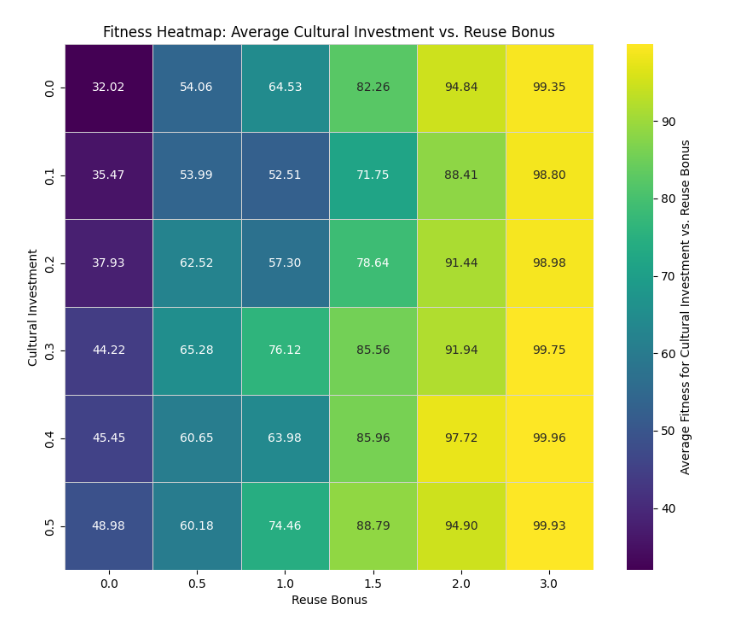
Insight: Bonuses for filing reports without tie-ins to downstream utility led to reduced benefits.
Method: Agent-Based Model (ABM) with OCEAN personality profiling.
Exploration: Mitigating Toxic Content Spread — Structural Containment avoiding Censorship
For a small-scale online social network (school environment), we simulated structural interventions to decouple network vitality from toxic content velocity. For the below hypothetical case study on platform safety, the model revealed that a 'selective permeability' architecture — high structural barriers (echo chambers) mediated by algorithmic bridges — far outperformed standard censorship. Strong homophily acted as a containment vessel for toxicity, while a boost for high-consensus content allowed it to tunnel through. We utilized a proprietary Agent-Based Model with OCEAN psychometric agents for this evaluation. (LLM-based agents were also explored in this study.) Note that the virtuous content detector was naive, based on variance in response times for students for different types of content, mediated by personality type. (If even the conscientious students forward the content, it is likely productive or harmless.)
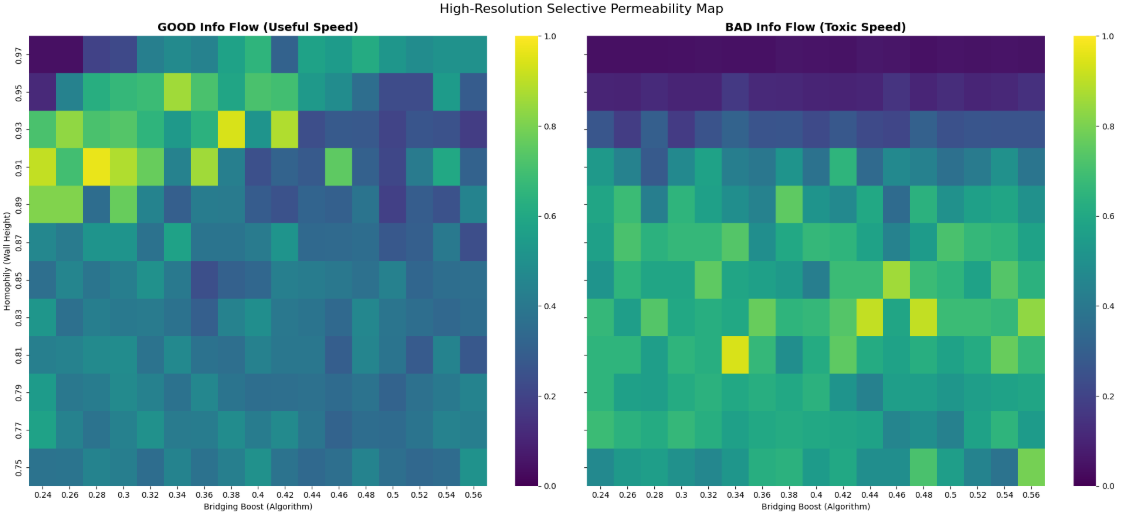
Method: Proprietary Agent-Based Model utilizing OCEAN psychometric agents, also including LLM-based agent exploration.
Note: Detection thresholds were modeled based on variance in response latencies across personality types. This is not a proven or recommended path for engineering a system.
Exploration: Simulating Organizational Connectivity Evolution
Still in development: We’re simulating a matrixed product organization using a variety of psychometric agents with prior relationships. The Early stages of the organization have tight network graphs within the functional silos, plus a few strong bonds corresponding to previous work or school relationships. By creating projects where people from multiple functional organizations work together on projects, we tend toward a more highly networked organization.
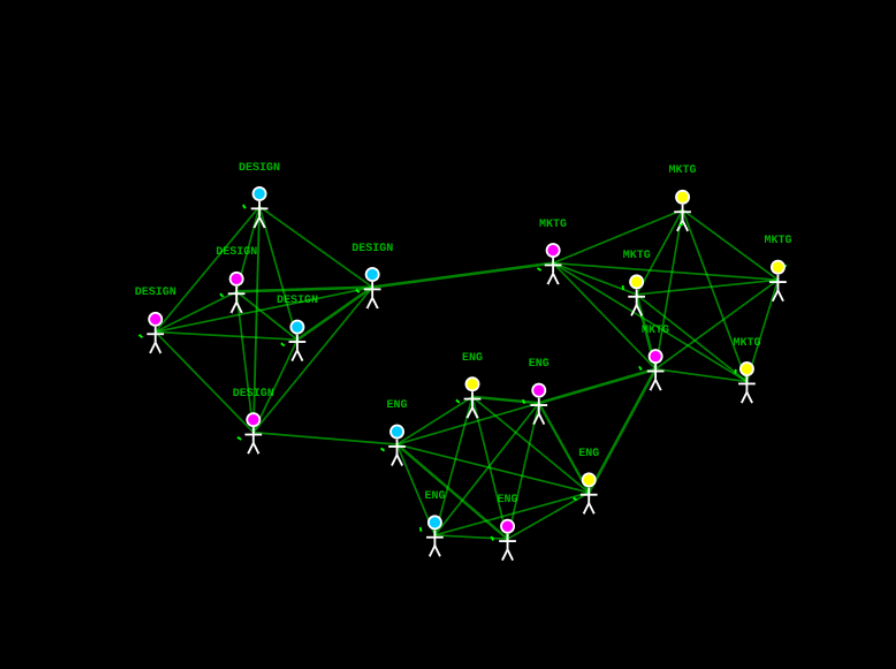
Initialized state: new organization with functional silos
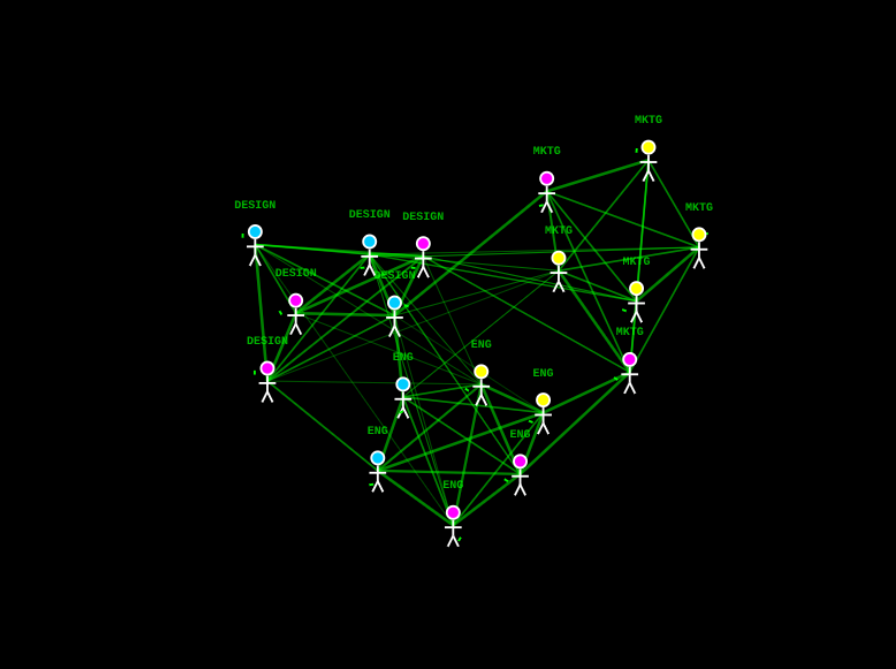
Evolved state: project assignments (indicated with agent head color) lead to a tighter network graph.